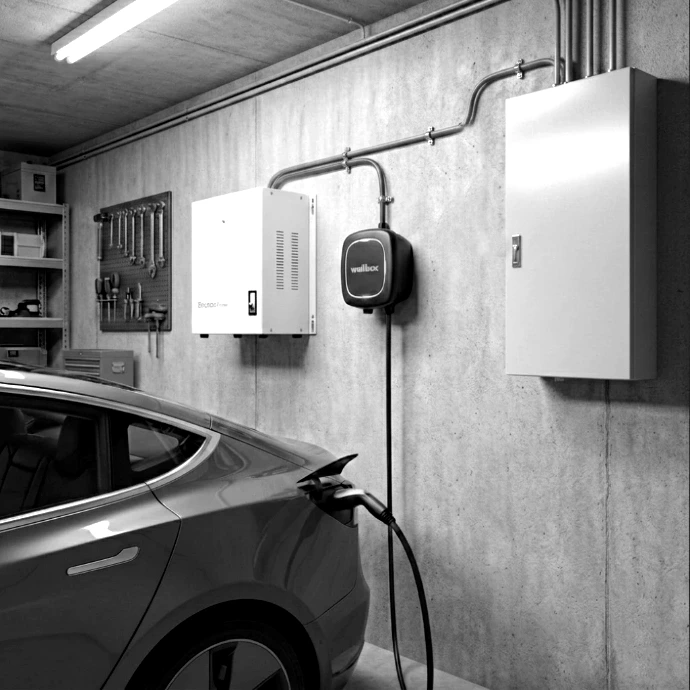
Many garages and outbuildings — especially in older installations in Southern Europe (Spain, Portugal, Italy, Greece) and in rural properties across the continent — have 230 V available but no neutral wire. Instead of the familiar 230 V between phase (L) and neutral (N), the voltage appears between two active conductors: 230 V L-L, or phase-to-phase.
Common names for this type of supply: IT network, 3×230 V network, 230 V delta network, ungrounded supply, or simply "230 V without neutral."
Most wallboxes and portable EV chargers expect 230 V L-N and require a defined reference potential to operate. The voltage is there — but the wallbox doesn't see the supply it needs.
Why a Larger Wallbox Won't Solve the Problem
Anyone running a new 32 A circuit (7.4 kW) will typically pull a neutral wire at the same time — solving the problem automatically. An isolation transformer makes sense for existing installations, and those are almost always protected by a 16 A breaker. A 32 A wallbox simply doesn't fit that setup.
The realistic use case is: existing installation, 16 A protection, no neutral wire, 3.6 kW charging capacity. That's exactly what the Bronson TT 5000 is designed for.
The Solution: A 1:1 Isolation Transformer (230 V → 230 V)
A 1:1 isolation transformer does not change the voltage. It provides galvanic isolation and allows a locally defined L-N system to be established on the secondary side.
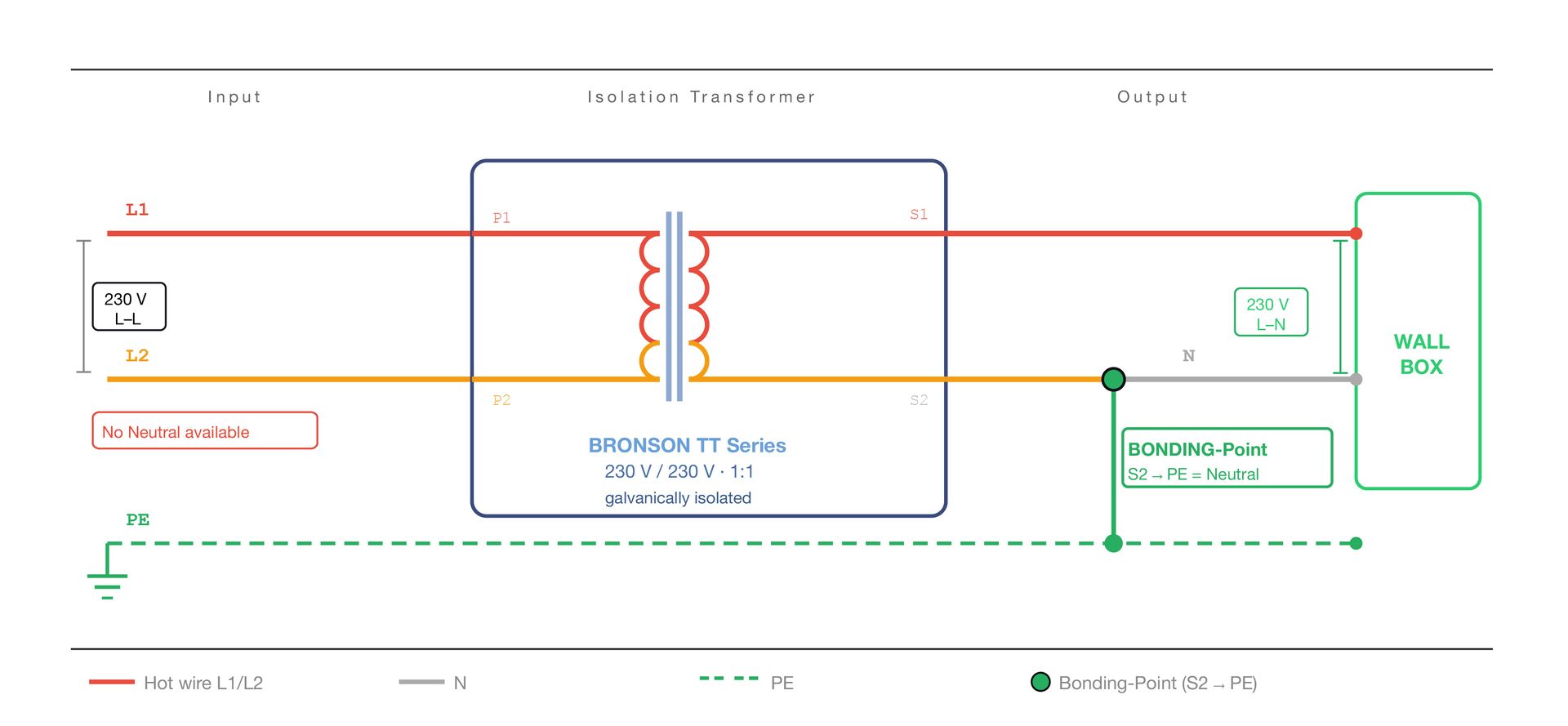
How It Works
Input (primary side): The electrician connects the available 230 V between the two active conductors (L-L) to the primary winding.
Inside the transformer: 1:1 ratio — no voltage change, but full galvanic isolation between input and output.
Output (secondary side): The electrician establishes a defined reference system by connecting one of the two secondary conductors (S2) to the protective earth (PE) — the so-called bonding point. This means:
- S2 becomes the neutral conductor (N)
- S1 becomes the line conductor (L)
Result: The wallbox receives a clean 230 V L-N supply at the output — exactly what it expects.
The bonding point must be implemented as a single, clearly defined connection point (typically at the transformer or the associated distribution board), in accordance with local regulations.
Which Transformer Size Do I Need?
EV charging is a continuous load. The transformer runs at full load throughout the entire charging session — unlike short-duration consumers. Adequate headroom is essential.
| Charging Power | Current at 230 V | Recommended Transformer |
|---|---|---|
| 3.6 kW | approx. 16 A | Bronson TT 5000 |
The TT 5000 provides the necessary continuous-duty reserve at 16 A charging current for reliable operation.
Protection and Installation
Which protective devices are required — circuit breakers, RCD types, disconnection conditions — depends on the country, network configuration, and wallbox model. The specific implementation must be carried out by a qualified electrician in accordance with local regulations.
Conclusion
Where 230 V is available but no neutral wire is present, the Bronson TT 5000 is the direct, reliable solution — no voltage conversion, full galvanic isolation, and sufficient continuous-duty capacity for 3.6 kW EV charging. The electrician creates a clean 230 V L-N system on the secondary side with a single bonding point — and the wallbox runs.
Frequently Asked Questions
Yes — using a 1:1 isolation transformer (230 V → 230 V) that provides a galvanically isolated secondary side. The electrician then establishes a defined L-N system by creating a single bonding point between the secondary conductor and protective earth.
Yes. If you have 230 V phase-to-phase (L-L) but no neutral conductor, an isolation transformer like the Bronson TT 5000 creates the L-N supply your wallbox needs. This is a common situation in older European installations and holiday homes in Southern Europe.
It means that 230 V is available, but there is no neutral wire. Most wallboxes and EV chargers require an L-N supply — the isolation transformer creates exactly that.
Older electrical installations in Southern Europe often use a phase-to-phase supply (IT network or delta network) with no neutral wire. Standard EV wallboxes expect a neutral conductor and won't operate correctly without one. An isolation transformer solves this.
In an existing installation without a neutral wire, the circuit is typically protected by a 16 A breaker. A 32 A wallbox exceeds this rating. Anyone installing a new 32 A circuit would normally pull a neutral wire at the same time — making the isolation transformer unnecessary.